Posts

Showing posts with the label mobile network

Cisco Packet Tracer | Download

Image
C isco Packet Tracer is a powerful network simulator that can be utilized in training for CCNA  TM  and CCNP  TM certification exam by allowing students to create networks with an almost unlimited number of devices and to experience troubleshooting without having to buy real Cisco TM  routers or switches. Cisco Packet Tracer features an array of simulated Application layer protocols (HTTP, DNS, …), as well as basic routing with RIP, OSPF, and EIGRP, to the extent required by the current CCNA  TM  curriculum. (Cisco Packet tracer labs available: Click here )

DNS (Video Tutorial)

Image

UDP & TCP (Video Tutorial)

Image

What is HTTPS (Video Tutorial)

Image

Electronic mail server

Image
What is a Mail Server A mail server is the computerized equivalent of your friendly neighborhood mailman. Every email that is sent passes through a series of mail servers along its way to its intended recipient. Although it may seem like a message is sent instantly - zipping from one PC to another in the blink of an eye - the reality is that a complex series of transfers takes place. Without this series of mail servers, you would only be able to send emails to people whose email address domains matched your own - i.e., you could only send messages from one example.com account to another example.com account. Types of Mail Servers Mail servers can be broken down into two main categories: outgoing mail servers and incoming mail servers. Outgoing mail servers are known as  SMTP , or Simple Mail Transfer Protocol, servers . Incoming mail servers come in two main varieties.  POP3 , or Post Office Protocol , version 3, servers are best known for storing sent and receive...

FTP- File Transfer Protocol

Image
The  File Transfer Protocol  ( FTP ) is a standard  network protocol  used to transfer  computer files  between  a client and server  on a  computer network . TCP Control use 20 ports Commands share by TCP control between the computer. Data Connection use 21 ports File is send by the Data connections. Functions: RETR STORE LIST Response message: 331: Username is OK 125: Data Connection open 425: Can't open Connection 452: Error  Tool: Filezila is the tool which is use the FTP and file share between the computers.

Cache Server

It is a kind of server which use an static IP and entertain the client's requests. A  cache server  is a dedicated network  server  or service acting as a  server  that saves Web pages or other Internet content locally .  It is placed at the switch, all the client firstly send request to the cache server, if the cache server has that particular page, it entertains the client without going to the internet. If the cache server has not that specific page, it sends request to the that particular page's server (over the internet) to get the data. When data is received the cache server entertain the client and also store that page to its database for later use. The stored pages in the cache sever check the last modify date before give to the client, if the page is updated by the server, the cache server itself get the latest updated page and then provide for the user. It is also called proxy server or sub-sever. Why we use cache servers: It saves the ...

TCP header fields

Image
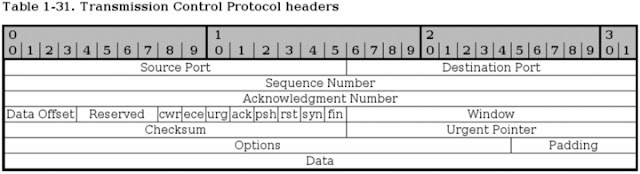
It consists upon approx. 9 fields. 1. Source Port 2. Destination port 3. Sequence number 4. Acknowledgement 5. Header length 6. Flag 7. Checksum 8. Urgent Pointer 9. Options Source port: It refers port number of the sender. Destination port: It refers to the port number of the receiver. Sequence number: It is used to set a number to each TCP packet so that the packet’s stream properly send or receive. It is later use in acknowledgement field to acknowledge that the perticular packet is sent. Ackowledgement: It is used to confirm that the spefic sequence numbered packet is received. Header length: It refers the length of the segment which have to transmit. Flag: These are the obe bit boolean fields used to control the trasnmission of the data accress the TCP connections. Some flags are: SYN, FIN, RESET, PUSH, URG, ACK Checksum: It is used to error free communication. It makes sure that the all the data is received on the destination withou...

UDP header fields

Image
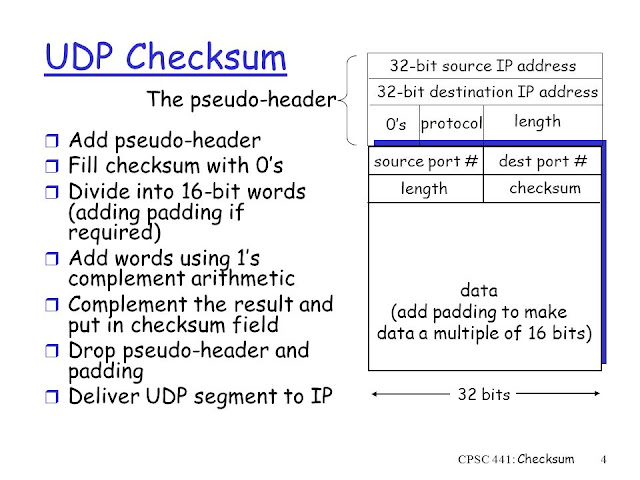
It is a 8 octet header which is consisting on four fields: 1. Destination port 2. Source port 3. Length 4. Checksum Destination port: The port number of the receiver by which the host entertain the client. Source port: The port number of the sender by which sender sends the data. Length: The length refers to the total size of the segment which is to transmit over the network. Checksum: It is used to detect the error the in the segments. The checksum also use to varify the integraty of the data. It give a delivery report to the sender about successfull sending of the data. UDP Psudo header Psudo header is considered when calculating the checksum. It is used some fields of IP header to trasnmit the error free data.

Key to Networking

Image
Key To Networking A complete and comprehensive approach to the networks OSI Models FDMA of shared medium  TDMA of shared medium Router in networking Routing table Packet Switching Circuit Switching  Core Network Fiber optics Standards of fiber optics FTTx (Fiber to the x) Guided Medium Unguided Medium Rj-45 Connector Coaxial cable Network Application Architecture Transport Layer Protocol Hyper text Vs Hyper Media Application Layer protocol Persistent Connections  Non-Persistent Connections RTT-Round Trip Time HTTP Request Message HTTP Response Message HTTP cookies Google panda working principle    Hypertext Vs hypermedia   Complete networking solution (Graduation level)   Verification Vs Validation   Microsoft Project Professional 2010 complete download with key    Cyber crime protection bill   Wardriving    50+ Java Interview questions (revised)   How google index you ...

HTTP cookie

Image
What is cookie An  HTTP cookie  is a small size text file sent from a web server and stored in the user's  web browser  while the user is browsing. Every time the user loads the website, the browser sends the cookie back to the web server to notify the user's previous activity in the whole website. What is could store Your activity on the website (all navigation) Your shopping items Your enter passwords Your Credit card numbers and pin Web contents Can any web server see any cookie from web browser No,cookies are given to a browser by the server. The browser reveals the cookies as applicable only to the domain that provided the cookie in the first place. Why as it develop Initially it is develop to monitor the two or many requests sent from one browser, later on it become much useful in authentication and other purposes.  Format of cookie Set-Cookie: <em>value</em>[; expires=<em>date</em>][; domain=...

HTTP message format (Response Message)

The message format of response message which is given by server on the request of client: (Status line) HTTP 11.1--200--ok (header) Connection -------close (in the case of non-persistent) Date ---------------response data and time Server-------------appache Last modify------web page's last modify data and time Content-----------(size) in KB Content-----------(Type) in html/text (body) {the response message which is given by server place here} The Response codes: 301 --------------------website name is changed.(new address is send in the response) 400 --------------------not understand the request message 200 --------------------response back 404 --------------------file nor found

HTTP message format (Request Message)

The message format of Get request message: (reference) GET----------------------index.html host-----------------------www.google.com (Header) Connection-------------Close (in case of non persistent) User agent--------------Mozila firefox 15.5 (name of browser) Accept language-------en Other important message from client to server: POST (for publish something in the web) DELETE (for delete some object) INSERT (for add something) PUT (for put something)

Guided media

As the name indicates, in guided media Electrical/Optical signals are passed through a solid medium (different types of cables/wires) As the path traversed by the signals is guided by the size, shape and length of the wire, this type of media is called guided media. Also, in guided media, the signals are confined within the wire and do not propogate outside of the wire/media. E.g., Copper Unshielded Twisted Pair (UTP), Copper Shielded Twisted Pair (STP), Copper Co-axial cables, Fiber Optic Cables. Twisted Pair Copper:  It is the most widely deployed media type across the world, as the last mile telephone link connecting  every home with the local telephone exchange is made of twisted pair copper. These telephone lines are reused as last mile DSL access links to access the internet from home. They are also used in Ethernet LAN cables within homes and offices. They support  low to High Data Rates (in order of Giga bits) However, they are effective o...

FTTX - Fiber to the x

The telecommunications industry differentiates between several distinct FTTX configurations. The terms in most widespread use today are: FTTP  ( fiber-to-the-premises ): This term is used either as a blanket term for both FTTH and FTTB, or where the fiber network includes both homes and small businesses. FTTH  ( fiber-to-the-home ): Fiber reaches the boundary of the living space, such as a box on the outside wall of a home.  Passive optical networks  and  point-to-point Ethernet  are architectures that deliver  triple-play  services over FTTH networks directly from an operator's  central office . [1] [2] FTTB  ( fiber-to-the-building, -business, or -basement ): Fiber reaches the boundary of the building, such as the basement in a  multi-dwelling unit , with the final connection to the individual living space being made via alternative means, similar to the curb or pole technologies. FTTD  ( fiber-to-the-desktop )...

Wardriving....searching for Wi-Fi

Wardriving is the act of searching for Wi-Fi wireless networks by a person in a moving vehicle, using a portable computer, smartphone or personal digital assistant (PDA). Software for wardriving is freely available on the Internet, notably NetStumbler, InSSIDer, Vistumbler or Ekahau Heat Mapper for Windows; Kismet or SWScanner for Linux, FreeBSD, NetBSD, OpenBSD, DragonFly BSD, and Solaris; and KisMac for Macintosh. There are also homebrew wardriving applications for handheld game consoles that support Wi-fi, such as sniff jazzbox/wardive for the Nintendo DS/Android, Road Dog for the Sony PSP, WiFi-Where for the iPhone, G-MoN, Wardrive, Wigle Wifi for Android, and WlanPollution for Symbian NokiaS60 devices. There also exists a mode within Metal Gear Solid: Portable Ops for the Sony PSP (wherein the player is able to find new comrades by searching for wireless access points) which can be used to wardrive. Treasure World for the DS is a commercial game in which gameplay ...

GSM:Global System of Mobile communication

GSM:           It stands for G lobal S ystem of M obile communication . It is the  type of network in which data is transmit in four different frequencies. Present GSM is Working on 2.7 GSM. Mobile:           It is the wireless device which is used to transmit the data (Voice, Text message, Multimedia message, E-mail etc.) from one mobile to another mobile. Data transmit : The mobile is connect with nearest base station (Tower), all the data firstly transmit to base station then the satellite and at the end it reaches at other mobile .